Windsor Chair Repairs
Home Windsor chairs Chairs available now Windsor Chair Repairs Glossary of terms Frequently Asked Questions About the Chairmaker Contact details
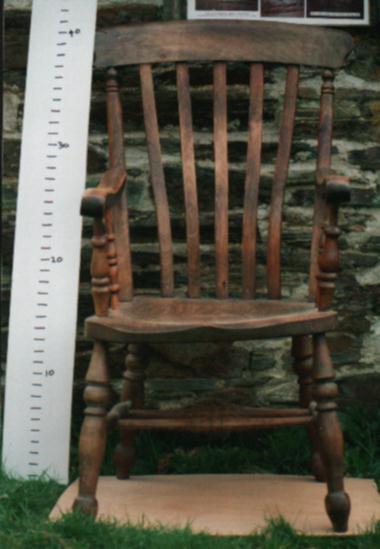
Windsor chair repairs. The photo is of a completed repair job. You can see that the seat had warped badly over time, twisting the whole structure and pulling some of the joints apart. I adjusted the lengths of the various components so that they fitted comfortably together, then I tightened and reglued the joints. This one also exhibits shortened legs. See question 3 below. But basically it was a good chair, retaining its original finish, and had only been badly repaired just the once!
I enjoy repairing Windsor chairs, but before even enquiring about repairs please ask yourself the following questions:-
1. Does the chair have enough value (either financial or emotional) to make it worth repairing? Making a decent job of a repair is time consuming. Making a bad job of a repair will completely ruin the chair.
2. Has the chair been badly repaired in the past? Some sure signs of bodged repairs are metalwork such as nails and screws, old white PVA adhesive in the joints, or maybe the odd piece of plywood here and there. Removing these can take an inordinate amount of time, and can leave holes which are difficult to hide.
3. Have the legs been shortened? Often chairs were left on damp floors and the bottoms of the legs got worm or rot and were gradually shortened to keep pace with the decay. I can sometimes extend legs back to the original length, but it takes time.
4. Would you be better off keeping your old chair and having a copy made? If the seat is badly cracked along the grain, or the bent bows have failed, this may be a sensible option. Your old chair will retain any antique value it has at present, and you will then have a new and sturdy chair to use. Of course if your old chair is absolutely unusable you might as well get it repaired as have a new one made.
5. Has the chair been sanded or dipped? If so, it is probably ruined anyway. Sanding removes all the original patina and surface texture, leaving a dragged up surface and scratch marks, and dipping usually cracks the seat and loosens all the joints. I cannot bring chairs like this back from the dead.
6. How will you get the chair to and from my place? I do not normally collect or deliver repairs.
If you're still reading I would be pleased to talk about chair repairs!
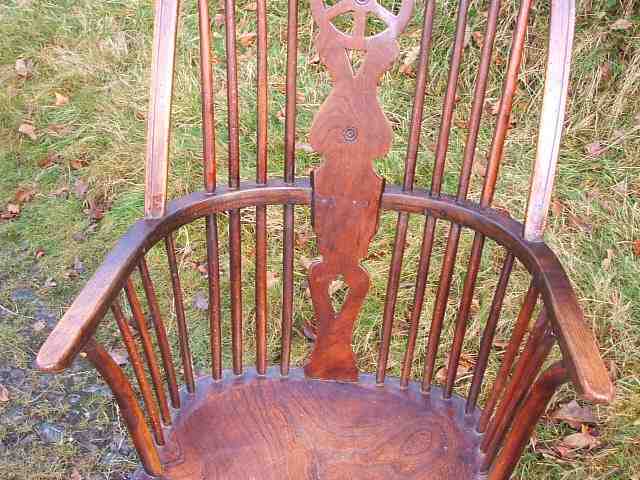
This is a new arm bow fitted to a fairly standard high back chair. The original Ash arm bow had been poorly bent, and had been "cut and shut" to try to get it to fit. It had also got worm, and had been broken and repaired with screws and glue. Some of the original spindles had been cut and joined end to end, so I had to be careful to reassemble them in their original places. The chair was unusable in its broken condition, so was worth repairing.
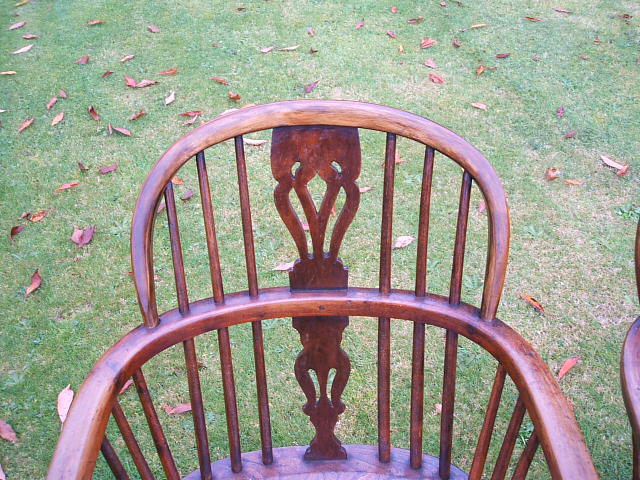
Here is a new top bow fitted to an antique yew wood yeoman's bow chair, which was part of a set of six, so worth spending some time on. A new former was made to exactly match the old curve, so that the new bend fitted properly. The yew wood was supplied by the customer from a branch off one of his own trees. Unfortunately I now have an allergic reaction to Yew wood dust so I am unlikely to do any more repairs in Yew wood.
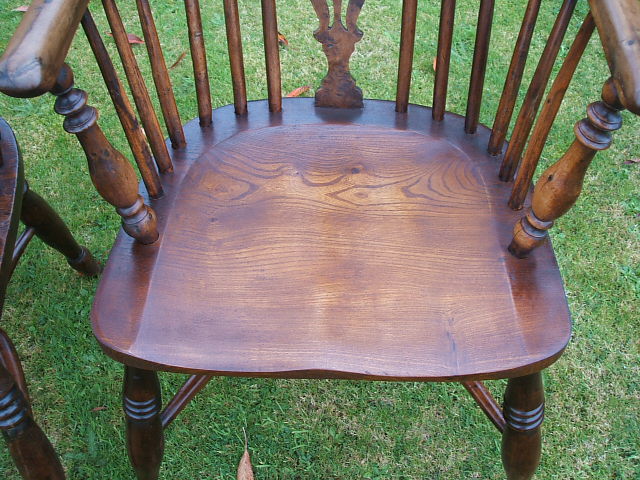
Possibly the ultimate challenge in repairing a Windsor chair is replacing a seat without dismantling the whole chair. This chair was part of the same set as the one above, and its seat was well and truly worm eaten, broken, and had no strength to stand up to a repair. The new Elm seat is shown here. It should be as strong as the original was when it was first made.